|
An overview of 2Axis(Rotating + Tilting) Welding Positioner
( Updated: Dec.,16th,2025 ) |
An overview of 2Axis(Rotating + Tilting)Welding Positioner
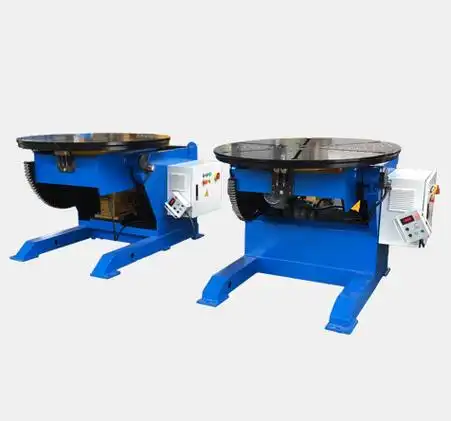 The Two-Axis Welding Positioner is a pivotal piece of equipment in modern welding workshops, designed to enhance precision, efficiency, and operator safety. By manipulating a workpiece along two independent axes, it provides optimal positioning for various welding tasks.
Structural Characteristics
1)Its core design features two primary mechanical movements: continuous 360-degree rotation (typically the main table) and controlled tilting (often up to ±135 degrees). This combination allows the workpiece to be presented at virtually any angle. Key components include:
2)Base & Frame:A robust, stable structure to support heavy loads and resist welding stresses.
3)Tilting Mechanism:Driven by a precision gearbox or similar drive system, connected to the rotating head.
4)Rotating Head/Table:The main work platform, equipped with fixtures or chucks, driven by a separate motor for smooth, variable-speed rotation.
5)Drive System:Comprises high-torque electric motors, reducers (often worm gear type for self-locking), and frequency inverters for precise speed control.
6)Control Pendant:A user-friendly, sometimes programmable, remote control for operating both axes independently or synchronously.
Applicable Welding Processes
This positioner is versatile and suitable for both automated and manual welding:
Target Industries
Its application spans industries requiring complex fabrication:
Operation Method
1)Mounting:Securely clamp or bolt the workpiece to the positioner table, ensuring its center of gravity is as close as possible to the axes' intersection to minimize unbalanced load.
2)Programming (if applicable):For repetitive tasks, program the desired rotation and tilt sequence (speed, angle, dwell time) into the controller.
3)Positioning:Using the pendant, manually tilt and rotate the workpiece to the optimal starting position for the weld seam—typically placing it in the flat position.
4)Welding:Initiate the welding process. For manual welding, the operator can use the pendant to make fine adjustments during the process. For automation, start the programmed cycle.
5)Completion & Unloading:After welding and cooling, return the positioner to a safe loading angle and remove the finished part.
In summary, the two-axis rotating and tilting welding positioner is a flexible and powerful tool that boosts productivity and weld quality across numerous industries. Its effective use hinges on proper workpiece loading, correct operation, and a rigorous, scheduled maintenance regimen. |
 |
|